


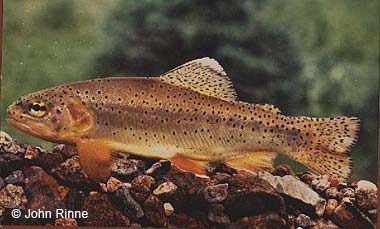
Apache trout (Oncorhynchus apache); photo © John Rinne / USFWS - Arizona Ecological Services (copyright policy).
Official State Fish of Arizona
The endangered Apache trout (Oncorhynchus apache) was designated the official state fish of Arizona in 1986. All State Fish
Found nowhere else in the world, Apache trout were nearing extinction caused by the introduction of non-native trout and early methods of livestock grazing, timber harvest and other land uses that impacted their habitat. The unique Apache trout is now returning to its native range (cold-water streams in the White Mountains of Arizona) after decades of cooperative protection and recovery efforts. Apache trout became one of the first species to be federally listed as endangered in 1969.
In the late 1800's, Apache trout were abundant throughout the estimated 820 miles of cold, gravel-bottomed streams in the White Mountains of Arizona. Historic photos and accounts show early settlers harvesting hundreds of Apache trout in a single trip. In the early 1900's, wildlife agencies began stocking non-native trout species into the streams and lakes of the White Mountains to increase fishing opportunities for Arizona’s fast-growing population.
These new fish (rainbow, brook, cutthroat, and brown trout) out-competed Apache trout for limited food and cover, preyed upon the young native trout, and began cross-breeding with Apache trout (compromising the genetic purity of each species). Apache trout were reduced to only 30 miles of stream habitat by the mid-1950's! The White Mountain Apache Tribe took the first critical steps to conserve the species in 1955.
Apache trout can grow to over 20 inches in length and weigh up to 5 pounds in hatcheries, though most wild Apache trout are less than 9 inches in length (due to the small stream habitats where they live). They have an olive-yellow body with a yellow or golden belly and black spots spaced evenly across the body and fins. Their head and fins are tipped with a white or orange color and two black spots are located fore and aft of the eye's pupil (visually appearing as a black band through the eye).
The Apache trout is a unique, native fish resource and an important part of Arizona’s natural heritage. Due to the successful efforts of the recovery team, the Apache trout was down-listed in 1975 from endangered to threatened. Apache trout may be considered recovered when 30 self-sustaining populations have been established within its historic range (to date, no fish species has ever been removed from the endangered species list, except those that have gone extinct).