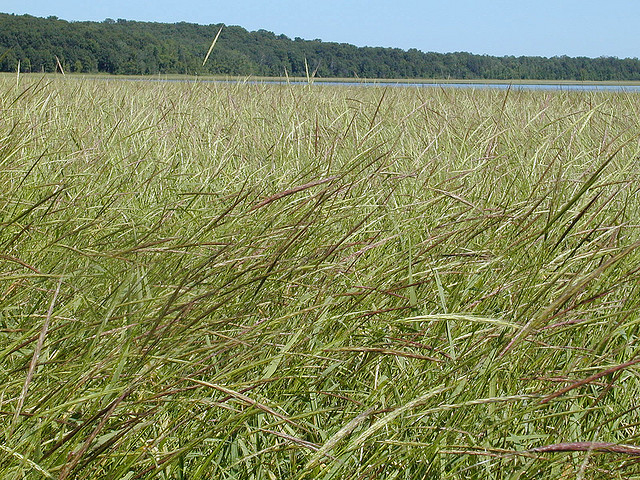
Natural wild rice bed in Minnesota; photo by Eli Sagor on Flickr (noncommercial use permitted with attribution).
Official State Grain of Minnesota
Minnesota designated wild rice as the official state grain in 1977. All State Foods & Agricultural Symbols
Wild rice (Zizania aquatica or Zizania palustris) is an aquatic grass not related to common rice.* Wild rice is native to North America and grows predominantly in the Great Lakes region. For many years, nearly all the wild rice produced in the world came from Minnesota, and most still does.
From Minnesota Department of Natural Resources; "Wild rice has a higher protein content than most cereal grains, making it a good food for wildlife and humans. Wild rice attracts many wild birds, especially waterfowl and red-winged blackbirds, and it also provides nesting cover for waterfowl."
Wild rice was a staple food of native Americans for centuries (particularly the Ojibway, Menomini, and Cree tribes in the North Central region of the continent). Minnesota natives called wild rice "manomin," which means "good berry" (wild rice has also been called Indian rice, marsh oats, Canadian rice, water oats, and blackbird oats).
Wild rice is a nutritional grain used in a wide variety of foods such as dressings, casseroles, soups, salads, breakfast cereals, mixes for pancakes, muffins, cookies and desserts. Wild rice has a high protein and carbohydrate content, and is very low in fat. Its nutritional quality (vitamins, minerals, protein) equals or surpasses other cereal grains such as wheat , oats, and corn.
*not to be confused with the wild form of common rice (Oryza) which is also called wild rice.